



Your Complete Roadmap to Becoming an EMT in Pennsylvania
Starting an EMT career in Pennsylvania requires the right training, national certification, and consistent exam preparation. This guide walks you through how to become an EMT in Pennsylvania, covering every requirement and step along the way. How To NREMT supports candidates with realistic practice tests, AI-powered tutoring, and a full training system designed to help you pass on your first attempt.
What It Takes to Qualify as a Pennsylvania EMT
Before starting the EMT certification process, make sure you meet the following Pennsylvania EMT requirements:
- Meet the minimum age requirement of 16 years old
- Hold a high school diploma or GED
- Have current CPR certification (BLS for Healthcare Providers)
- Be physically and mentally fit for EMT duties
- Complete a background check
- Meet other requirements, including a valid driver's license, proof of immunity, and malpractice insurance
Once you're approved, you can enroll in one of the state's EMT course programs.
Your 7-Step Journey to Pennsylvania EMT Certification
Becoming an EMT in Pennsylvania involves completing approved training, earning your National Registry certification, and finishing the state's certification process across seven key steps.
Step 01
Find Your Pennsylvania-Approved EMT Course
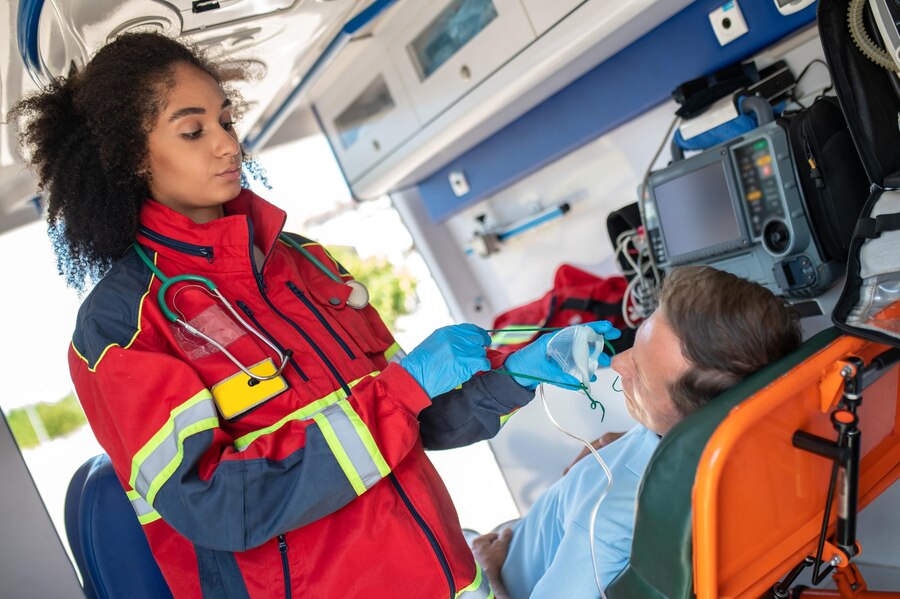
In Pennsylvania, EMT programs must be approved by the Department of Health, Bureau of EMS. These courses are taught at local EMS agencies, community colleges, and technical schools, following a blended format that includes classroom-based learning, clinical or ambulance ride-alongs, and hands-on skills training. After completing the course, you become eligible to take the NREMT cognitive exam.
Step 02

Sharpen Your Practical EMT Skills
Your training prepares you for more than the cognitive exam. It builds the practical skills and clinical judgment you'll need as an EMT — from patient assessment to emergency response. Completing your hands-on training during this stage helps confirm you're ready to apply your knowledge in real patient-care situations.
Step 03

Master the Updated NREMT Exam Domains
The National Registry recently updated its exam domains to reflect current patient care needs, an important part of any NREMT Cognitive Exam Prep. Candidates should focus on the following areas:
- Scene Size-Up and Safety — assessing the scene for hazards and ensuring safety for the team, yourself, and the patient
- Primary Assessment — evaluating immediate life threats and the patient's level of consciousness
- Secondary Assessment — thoroughly assessing the patient's history and physical condition
- Patient Treatment and Transport — administering appropriate care and preparing patients for transport
- Operations — EMS operations such as communication and safety procedures
Pediatric patient-care content is integrated throughout all domains.
Step 04

Get Exam-Ready and Take the NREMT Cognitive Exam
The NREMT cognitive exam is a computer-adaptive test that adjusts its difficulty based on your answers, containing 70–120 questions. The exam has a higher failure rate for first-time test-takers — not because students don't study, but because they don't study the right way. How To NREMT offers a full library of NREMT practice exams, a 10-step training plan, and 24/7 access to "How To," our AI-powered tutor to answer your questions whenever you're stuck.
Step 05
Gather Your Pennsylvania Certification Paperwork
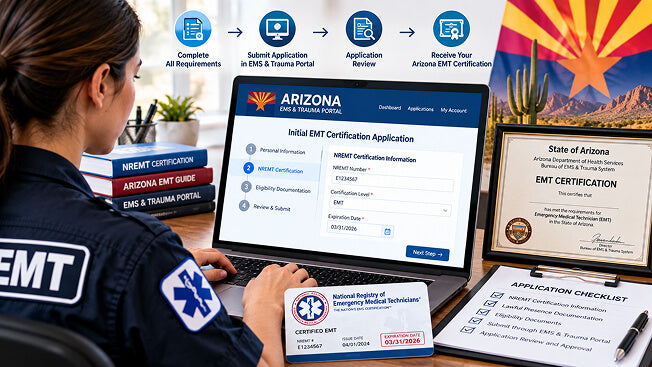
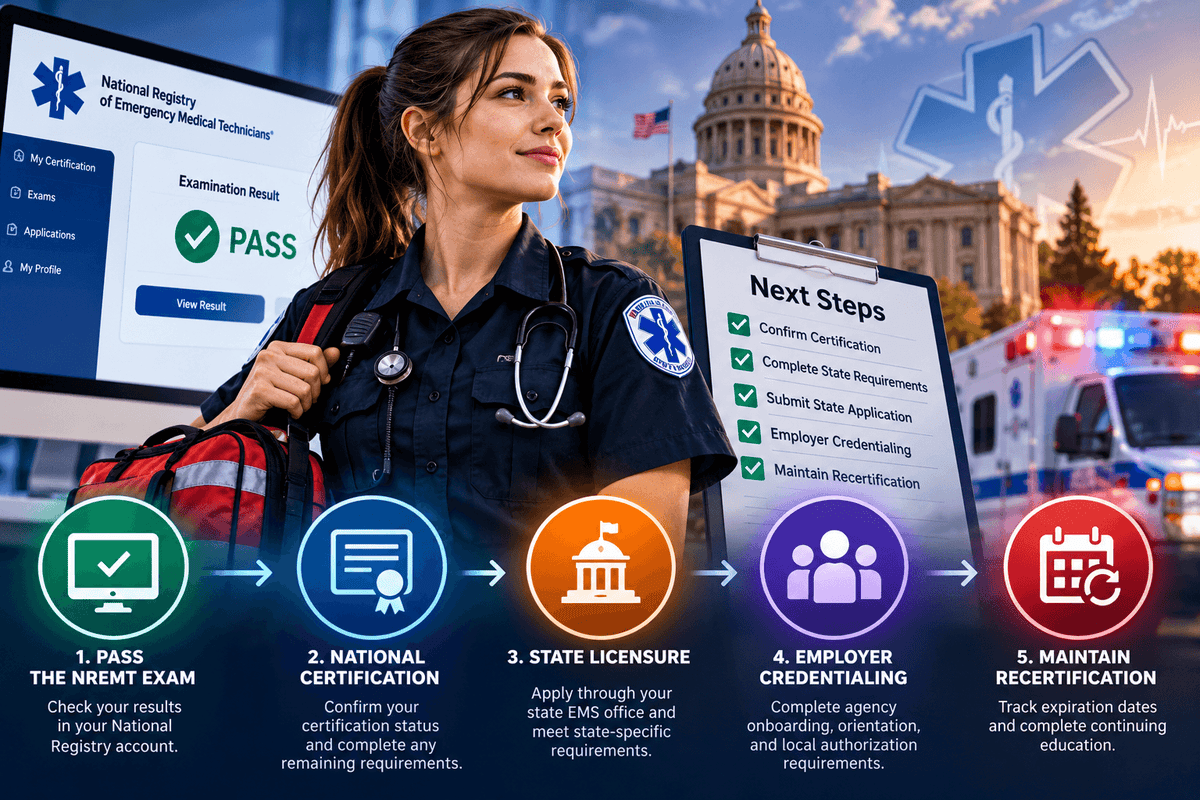
After passing your NREMT cognitive exam, gather the remaining documentation required for state certification — your NREMT passing result, course completion evidence, CPR certification, and background check — before submitting your application.
Step 06
Submit Your Application to the Pennsylvania EMS Registry
Apply through the Pennsylvania EMS Registry, uploading proof of EMT course completion, your NREMT cognitive exam results, CPR certification, background check, and the required application fee. Once approved, you'll receive your Pennsylvania EMT credential and can begin working as an EMT in the state.
Step 07
Stay Certified and Renew on Time
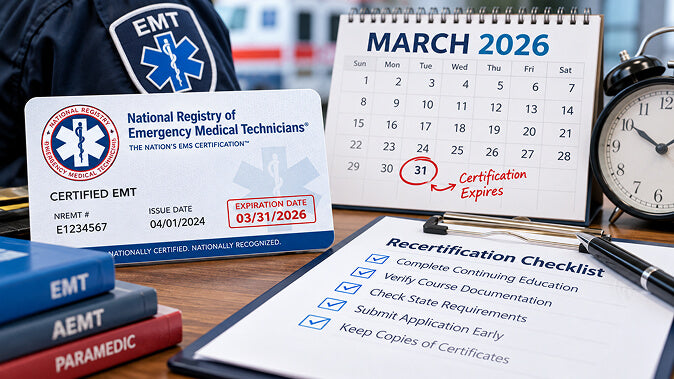
Pennsylvania EMT credentials are valid for three years. To renew, you'll need to keep your CPR certification current, complete required continuing education, and either maintain your NREMT certification or meet state renewal standards. Letting your certification lapse means added tests or courses, so staying current is important.
NREMT vs. Pennsylvania EMT Requirements: Know the Difference
| Requirement | National Requirements | State Requirements |
|---|---|---|
| EMT Course | Required | Must be Pennsylvania-approved |
| NREMT Cognitive Exam | Required | Required |
| CPR Certification | Required | Required |
| Background Check | Not required | Required |
| Psychomotor Skills | Discontinued | Required |
| State Application | Not applicable | Required |
Note: The hands-on skills test is discontinued by the National Registry and is only a state-level requirement in Pennsylvania.

Why Pennsylvania EMTs Trust How To NREMT
You're not alone — the NREMT cognitive exam has a higher failure rate for first-timers, and success comes down to studying the right way, not just harder. About 70% of How To NREMT members are first-time test takers who want the most efficient, effective prep. The other 30% are retakers determined not to repeat past errors. With How To NREMT's Pennsylvania EMT training programs, you can build the confidence and readiness you need. Here's what makes our prep stand out:
- A 10-step training plan that cuts through confusion
- Over 2,000 NREMT-style practice questions with explanations
- A live NREMT prep class through Zoom, with instructors ready to answer questions
- 24/7 access to How To, your AI-powered NREMT prep tutor
- Full preparation for Technology Enhanced Items (TEIs), including drag-and-drop and multi-step scenarios
- A 7- or 14-day EMT boot camp in Pennsylvania via Zoom, so you can prep live and stay on track before test day

How the NREMT Tests More Than Just Facts
The NREMT isn't just multiple-choice — it measures how well you perform under pressure. You'll face situations where multiple answers seem correct, scenario questions that test your judgment, and newer question types like drag-and-drop and build lists. That's why you need more than traditional review — you need practice with real feedback, which is exactly what a dedicated NREMT prep tutor and structured coaching provide.
FAQs
Is the psychomotor exam still required for EMT certification?
Not nationally — NREMT discontinued it. Pennsylvania still requires its own state psychomotor skills test.
What format is the NREMT cognitive exam?
A computer-adaptive test with 70–120 questions that adjusts its difficulty based on your answers.
What happens if I don't pass the NREMT exam on my first try?
You can retake it. Review your weak areas and use practice exams before your next attempt.
How long does Pennsylvania EMT certification last?
Three years. You'll need to renew with continuing education and a current CPR certification.
What documents do I need to apply for my Pennsylvania EMT certification?
Proof of EMT course completion, your NREMT passing result, CPR certification, background check, and the application fee.
Does How To NREMT offer a personal NREMT prep tutor during exam prep?
Yes — 24/7 access to How To, our AI-powered tutor, plus a 7- or 14-day live exam prep boot camp via Zoom, held four times a year with limited spots.
- Choosing a selection results in a full page refresh.