



Your Guide to Becoming an EMT in North Carolina
When emergencies happen, EMTs are often among the first trained professionals to provide care. In North Carolina, EMTs serve patients across many settings, from mountain communities to coastal areas. Starting this career requires approved education, hands-on skills, examination requirements, and state credentialing. Understanding how to become an EMT in North Carolina can make the process easier to follow. How To NREMT helps EMT candidates prepare with practice questions, tutoring, and AI-powered study tools designed for the current NREMT exam.
North Carolina EMT Requirements
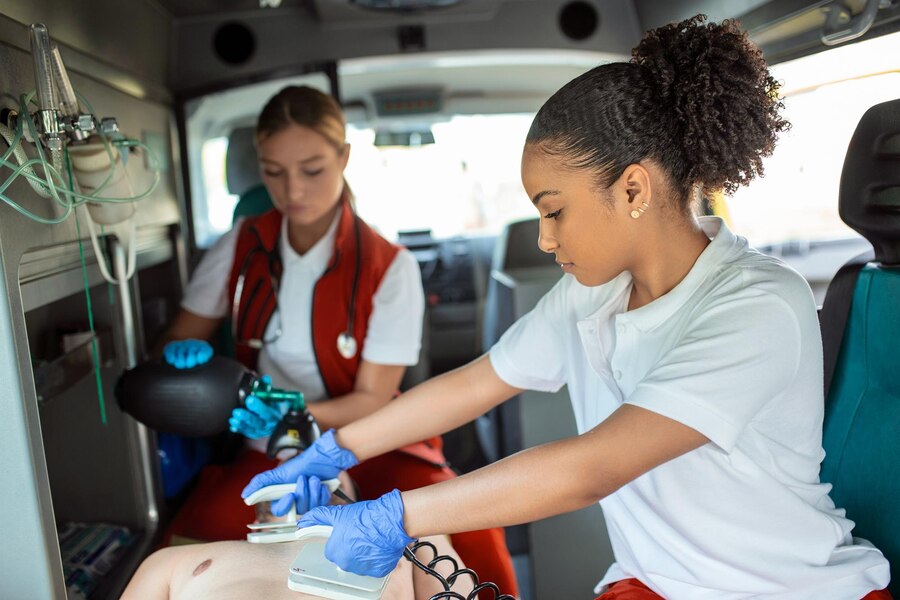
Before starting the EMT certification process in North Carolina, make sure you meet the following requirements:
- Be at least 18 years old to receive a North Carolina EMS credential
- Have a high school diploma or GED
- Complete an NCOEMS-approved EMT program
- Complete the required skills evaluation
- Pass the required written examination
- Hold current healthcare-provider CPR certification
- Complete the required criminal background review
- Meet additional program requirements, such as required immunizations
Your North Carolina EMT Path: 7 Key Steps
The road to North Carolina EMT certification includes education, practical training, examinations, and state credentialing. Follow these steps to understand what comes next.
Step 01
Check Your Eligibility First
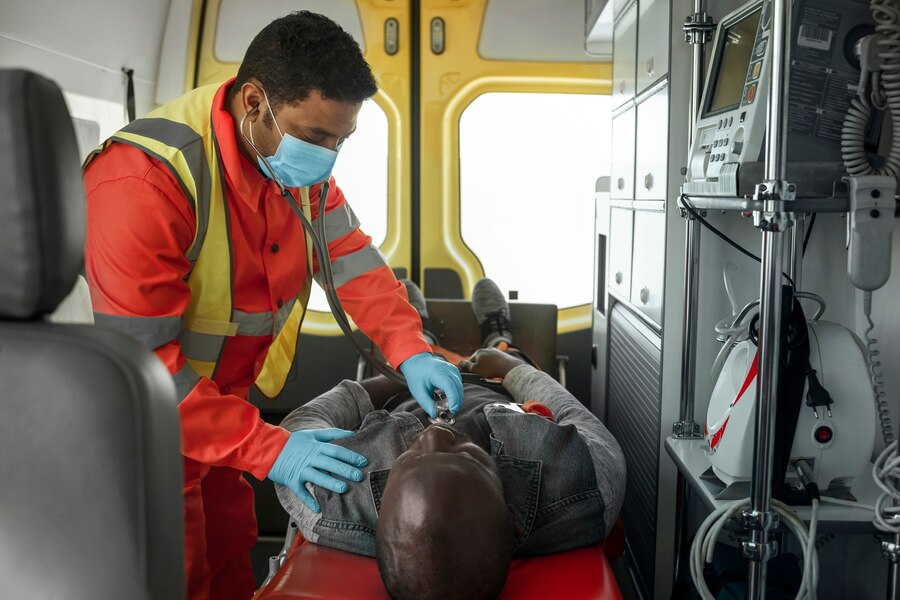
Before enrolling in a North Carolina EMT course, make sure you meet the program and state requirements.
- You must be at least 18 to receive a North Carolina EMS credential. Students may take the EMT state examination at 17, but the credential is held until they turn 18.
- Have a high school diploma or GED. Some programs may accept an entrance assessment showing the required reading level.
- Hold current healthcare-provider CPR certification.
- Complete the required criminal background review.
- Be physically and mentally capable of performing EMS duties.
- Meet any program-specific requirements, such as TB, COVID-19, or flu immunizations.
Step 02
Complete NCOEMS-Approved Education
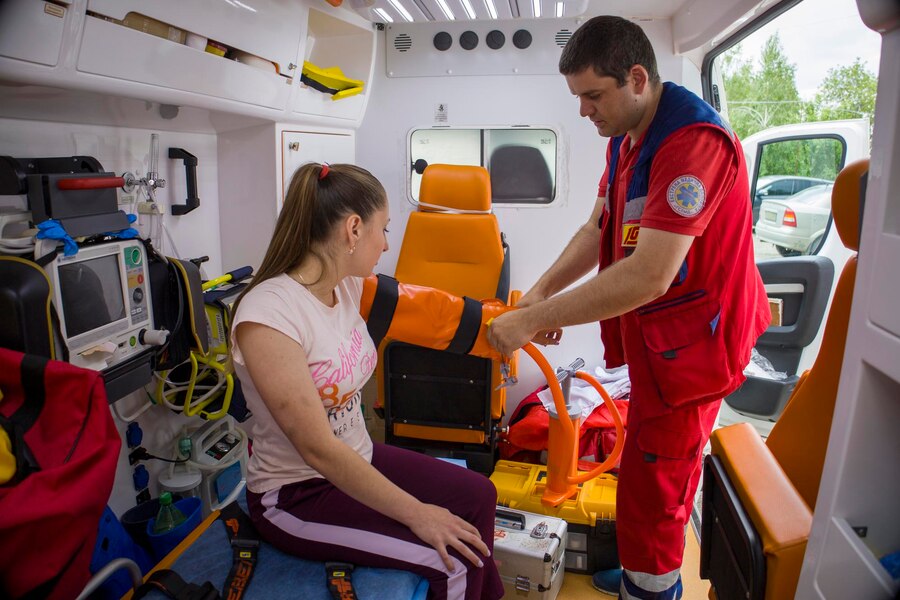
Complete your North Carolina EMT course through an NCOEMS-approved education program. Training is available through community colleges, EMS training centers, and technical schools.
Your North Carolina EMT training may cover:
- Classroom instruction
- Hands-on skills practice
- Clinical experience
- Field internships
Once you complete the approved program, you can move on to the required examination process.
Step 03

Build Your Hands-On EMT Skills
Becoming an EMT requires more than classroom knowledge. Your training must help you develop the practical skills needed to assess patients, respond to emergencies, and provide safe care.
North Carolina requires a scope-of-practice performance evaluation as part of the credentialing process. The skills evaluation covers the practical abilities you need to perform at the EMT level. The North Carolina EMT practical skills exam is part of the hands-on competency process, so use your training time to practice skills and patient-care procedures with confidence.
Step 04
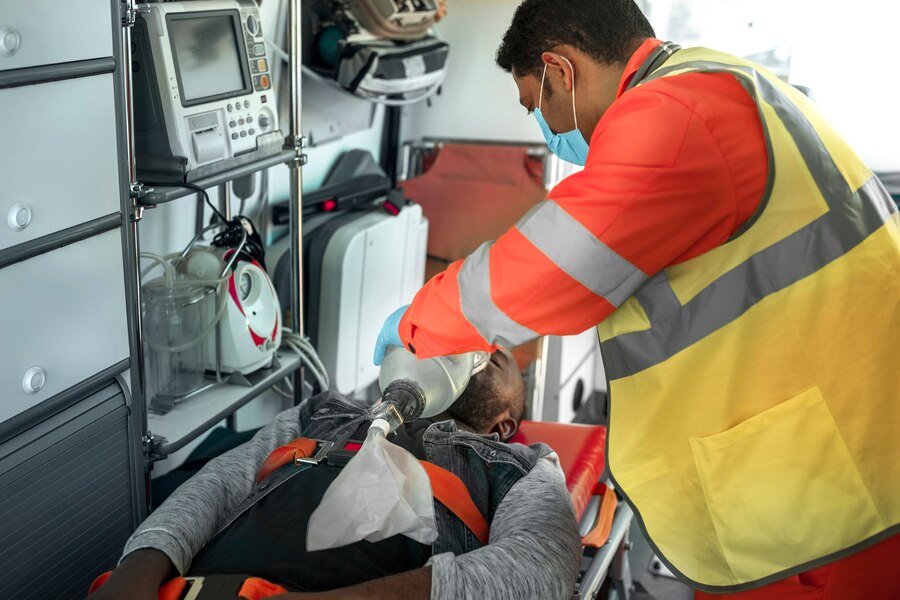
Get Ready for the NREMT Cognitive Exam
The NREMT cognitive exam is a computer-adaptive examination that tests your ability to apply EMT knowledge to patient-care situations. The updated EMT examination launched on April 7, 2025. It includes 70–120 items and has a two-hour time limit.
For NREMT preparation, North Carolina candidates should focus on the current exam format, clinical reasoning, patient assessment, and applying knowledge rather than relying only on memorization.
The current EMT examination covers five domains:
- Scene Size-Up and Safety
- Primary Assessment
- Secondary Assessment
- Patient Treatment and Transport
- Operations
Pediatric patient-care content is integrated throughout these areas. The updated exam also includes technology-enhanced question types designed to assess different ways of applying knowledge. Effective NREMT cognitive exam preparation should include realistic practice questions, clinical reasoning drills, and review of missed questions.
Step 05
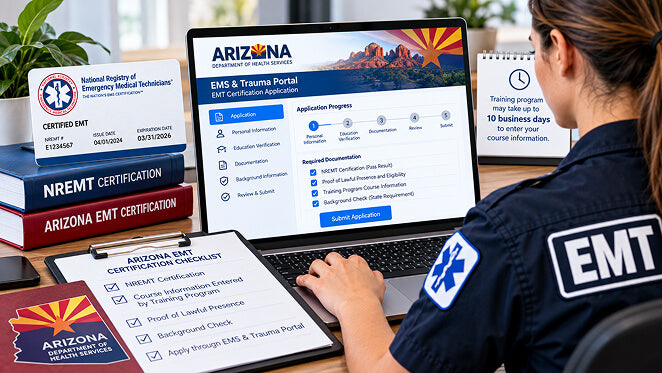
Complete the Required Exam Process
After completing your approved education, you must pass a written exam through NCOEMS or an NCOEMS-approved equivalent. Eligible candidates may also test with the National Registry. The exam includes scenario-based and clinical decision questions, so focus on applying knowledge, not just memorizing facts. For NREMT exam North Carolina requirements, follow the exam pathway that applies to your credential.
Step 06
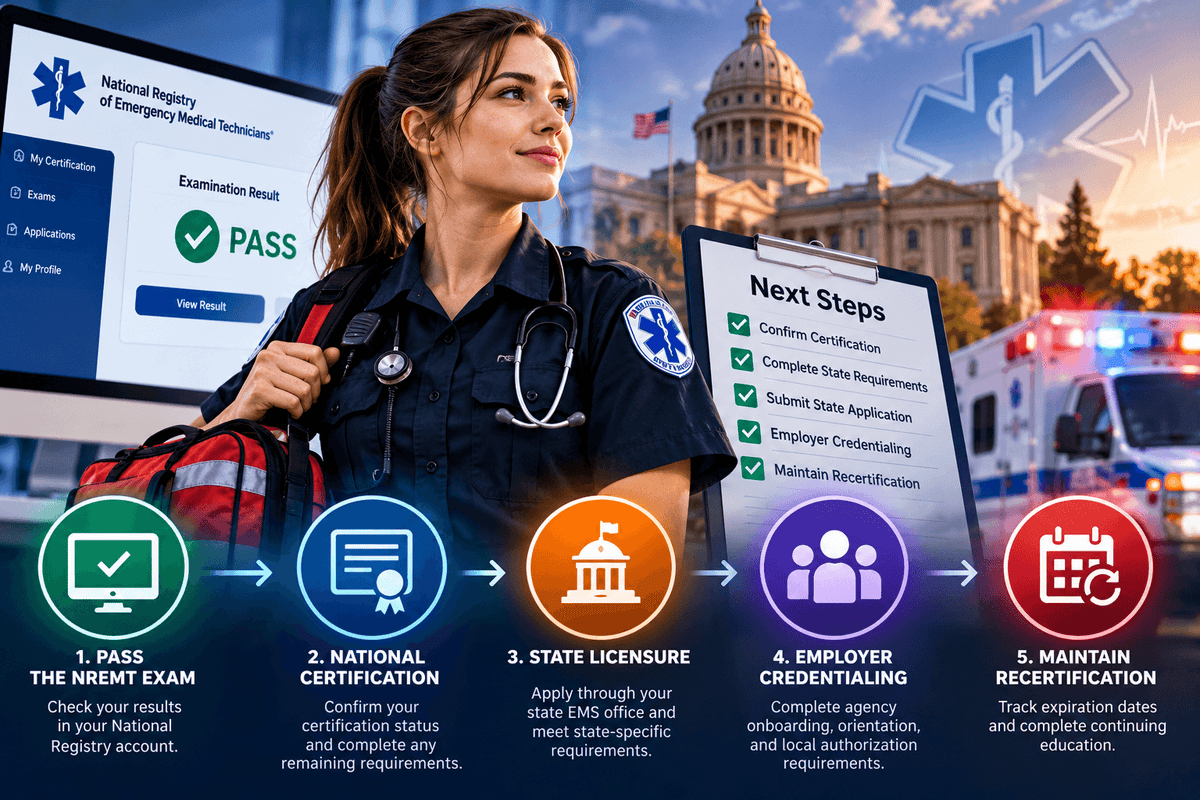
Apply for Your State Credential
Once you have completed the required education, skills evaluation, and examination process, you can complete the North Carolina EMS credentialing requirements. NCOEMS reviews applications and criminal background histories for individuals applying for, renewing, or holding EMS credentials. Depending on your circumstances, fingerprinting may also be required.
Have your required information and documentation ready before submitting your application. Incomplete applications may be returned without processing. Although people often search for a North Carolina EMT license, North Carolina officially uses the term EMS credential for this state authorization.
Step 07
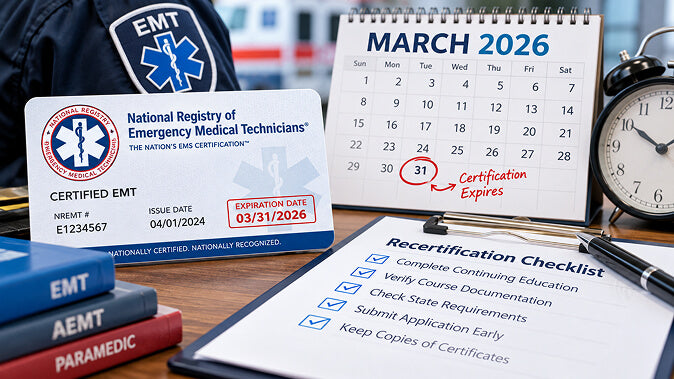
Keep Your Credential Active
North Carolina EMT credentials are valid for four years. To renew, complete the required 80 hours of continuing education, maintain CPR certification, and meet current state requirements. An active National Registry credential may also be used for renewal. If your credential expires, you may need refresher education and a written exam, depending on how long it has been expired.
NREMT and North Carolina: What Each Covers
National Registry certification and North Carolina state credentialing are related, but they are not the same process.
| Requirement | NREMT | North Carolina |
|---|---|---|
| Approved EMT Education | Required | Required |
| Cognitive Examination | Required for NREMT certification | NCOEMS exam or approved equivalent |
| BLS Skills Competency | Required through the applicable state-approved process | Required |
| CPR Certification | Required | Required |
| Criminal Background Review | Not a National Registry credential requirement | Required |
| State Application/Credential | Not applicable | Required |
| Continuing Education | Required for renewal | Required for renewal |
North Carolina requires approved education, skills competency, a written examination, and criminal background review as part of its state credentialing process.
Note: The National Registry states that BLS skills competency requirements for EMR and EMT levels continue in the state-approved format. The 2024 ALS psychomotor changes do not apply to EMT candidates.

How To NREMT: Your Guide to NREMT Success
Preparing for the NREMT can feel challenging, especially for first-time test takers. About 70% of How To NREMT members are first-time test takers, while 30% are repeat test takers. How To NREMT provides focused exam preparation, realistic practice, expert guidance, and study tools based on the current NREMT exam format.
- 10-Step Study Plan – Follow a clear plan that guides you through your exam preparation.
- 2,000+ NREMT Practice Questions – Practice with questions designed around the NREMT testing style.
- Unlimited Live Group Coaching – Join live Zoom sessions with experienced EMS educators.
- 24/7 AI-Powered NREMT Tutor – Get study support whenever you need it.
- Full TEI Preparation – Practice drag-and-drop, build-list, and multi-step clinical decision questions.
Whether you are preparing for your first NREMT attempt or trying again after an unsuccessful attempt, focused preparation can help you understand the exam format and strengthen areas that need more practice.
FAQs
What Are the Basic North Carolina EMT Requirements?
You must complete an approved EMT education program, meet the required age and education standards, complete the required skills evaluation, pass the required written examination, and complete the required criminal background review.
How Long Is a North Carolina EMT Credential Valid?
A North Carolina EMT credential is valid for four years. You must complete the required continuing education and renewal process to keep it active.
Do I Need to Take the NREMT Exam in North Carolina?
North Carolina requires a written credentialing examination administered by NCOEMS or an examination approved by NCOEMS as equivalent. Candidates should follow their education program and state requirements to determine the appropriate examination pathway.
Is a Practical Skills Evaluation Required?
Yes. North Carolina requires BLS skills competency as part of the state credentialing process.
What Happens If My North Carolina Credential Expires?
The requirements depend on how long the credential has been expired. You may need additional education, a refresher course, a skills evaluation, and a written examination before the credential can be reinstated.
- Choosing a selection results in a full page refresh.